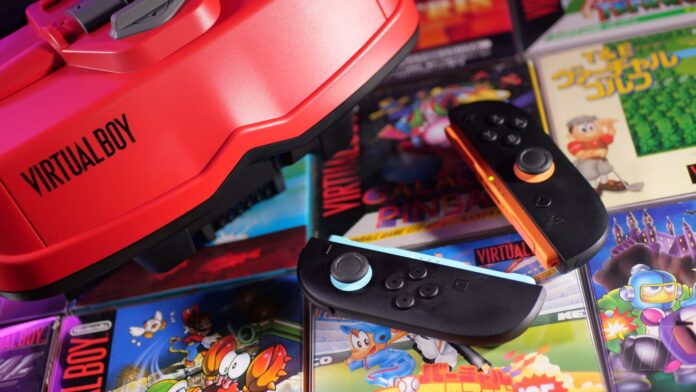
Only Nintendo could get its fans excited about a re-release of one of its most dramatic commercial flops, and, as somebody who is old and grey enough to recall the disaster that was the Virtual Boy the first time around, I find it endlessly amusing that its resurrection as a Switch accessory has caused such interest.
But then again, this is a platform that arguably deserves a second look, despite its well-documented shortcomings.
The brainchild of the late, great Gunpei Yokoi, the Virtual Boy was supposed to be another Game Boy-sized smash hit, but its undercooked tech (Yokoi reportedly wanted to work on it longer than Nintendo would allow), uncomfortable setup, and lack of convincing software support saw it dropped from stores less than a year after its release in 1995.
Yet, there’s nothing quite like the Virtual Boy – outside of those battery-powered Tomytronic 3D handhelds from the 1980s. perhaps. Even when compared to modern-day Virtual Reality headsets, Nintendo’s stab at the technology has a charm all its own – and it’s now possible to experience it without having to shell out for an original unit (I’ll get to why that’s important shortly).
In case you weren’t aware, there’s no actual working tech inside the modern-day Virtual Boy – it’s essentially a caddy into which you place your Switch 1 or 2 (I’d advise you do this gingerly, by the way, as it feels like there’s potential for scratches and scrapes on your console’s screen, despite the presence of some rubber pads – it’s quite an awkward fit).
The image on the Switch’s screen is displayed in the famous ‘Virtual Boy red’, an effect which is reinforced by a pair of red-coloured lenses (these are needed because the main Virtual Boy NSO menu, where box art is displayed, is in colour). The stereoscopic effect comes courtesy of the same lens section that originally shipped with the Labo VR headset – you can even remove the red lens section to reveal it.
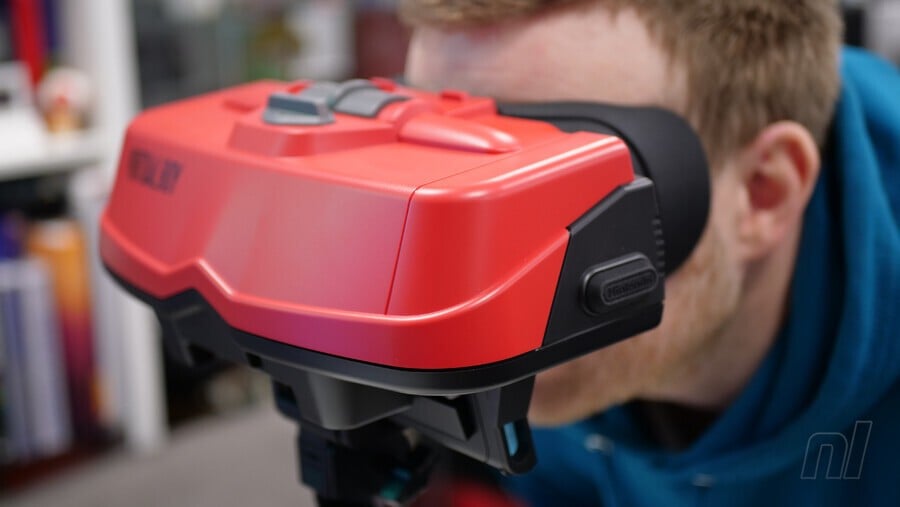
While the old and new Virtual Boys look almost identical when placed side-by-side, there are several subtle differences.
The controller port, volume dial, and 3.5mm headphone socket aren’t present on the new version, although Nintendo has been cute enough to mould them into the casing regardless. Likewise, the IPD / interpupillary distance and focus controls are purely for show – you can adjust the latter in-app, however.
The stand is also slightly higher on the new model, to allow the Switch console to poke out of the bottom of the main unit.
As for the stand itself, it’s possible to use it with the original Virtual Boy, which is good news for those of you who have cracked stands – this is a very common problem on older units, with the failure point being where the two legs ‘click’ outwards.
Being able to replace the original stand with this new one is great, but it sadly doesn’t work in the opposite direction; because it has two prongs that lock into the body of the original 1995 Virtual Boy, the old stand cannot be used with the resurrected model.
It also seems that replacing the ‘eye shade’ on the 2026 version isn’t as straightforward as it was on the 1995 edition. Back in the day, you could easily pop off the existing eye shade and clean or replace it, but with the new variant, it doesn’t appear to come away as easily – and I’m not brave enough to force it to find out. However, Nintendo does list it as a separate component on the box, so I’d assume it can be removed when the time comes. (Ollie has done it, although it took “a little bit of force.”)
The visual experience is recreated almost flawlessly; I constantly switched between an original Virtual Boy and the new offering to gauge the difference, and while the pixels on the Switch 2’s screen are more noticeable than those on the legit VB, the effect is still pretty faithful.
The way audio is handled is similar, too, with the Switch speakers serving as a pretty competent replacement for the Virtual Boy’s built-in offerings. The ‘fake’ 3.5mm headphone jack means you can’t connect a pair of wired headphones like you could in 1995, however. You’ll have to opt for wireless alternatives in 2026.
On the downside, the biggest drawback of using a Virtual Boy — the fact that you’re hunched over, gazing into a table-mounted headset — is also present and correct in this version.
While many people complain about eye strain and headaches when using the machine, my biggest gripe was always the fact that my neck would hurt after even a short period of time. The same is absolutely true here, and, unless you get your seating position totally perfect, you can expect to feel some discomfort after just a few minutes of play.
It’s little wonder, then, that Nintendo felt compelled to put an ‘Automatic Pause’ option into each Virtual Boy game back in the day; when enabled, this encouraged you to take a short break after around 20 minutes – essential not just to avoid eye strain, but also to allow you to stretch your back and move your neck around a bit. The feature is present in all of the games available for this new version.
Nintendo hasn’t gone as far as to replicate the Virtual Boy’s unique controller, which is a shame but not the end of the world. The dual-pad setup is reproduced well on the Switch Joy-Con’s analogue sticks, with the ‘A’ and ‘B’ buttons taking the place of the (you’ve guessed it) ‘A’ and ‘B’ buttons of the original pad.
I’m actually of the opinion that the Virtual Boy controller isn’t one of Nintendo’s finest hours, so I prefer the setup Nintendo has offered here – plus, I dread to think of how much more expensive this thing would be had the company chosen to recreate the pad, as well.
The price of this new Virtual Boy really does need mentioning, because, at almost £70 / $100, it’s not what I would call an impulse purchase.
I’ve already seen people online lamenting how easily they were suckered by Nintendo-related FOMO when it was first announced, and I absolutely get it. The original Virtual Boy is a standard-issue piece of furniture in the gaming room of any self-respecting fan (if it’s good enough for George Costanza, it’s good enough for me!), so this is a cheaper way of improving your decor, if nothing else.
As I hinted earlier, it’s also a hassle-free way of experiencing the Virtual Boy’s meagre library, as owning an original unit is fraught with challenges.
I’ve already mentioned the fragile stand (my first Virtual Boy suffered from this), but there’s also the problem of the glue on the ribbon connectors inside the unit failing over time; like the infamous horizontal lines on a monochrome Game Boy’s LCD, the Virtual Boy’s monochrome red screens are prone to developing a horizontal line fault similar to that seen on the Game Boy’s LCD.
It’s possible to repair this fault, but it’s not a cheap exercise. During my review period, I was dismayed to notice that my own Virtual Boy had developed this very same issue, so in one way, this new accessory couldn’t have come at a better time for me personally.
Ultimately, there’s no escaping the fact that, as a concept, the Virtual Boy is utterly flawed.
It would work better as a headset you could attach to your face (something Nintendo actually promised at one point in the ’90s, before it became clear the product was a dud), and, while titles like Virtual Boy Wario Land, Red Alarm, and Vertical Force are decent, the system suffers from a dire lack of must-have games, rendering it more of a curiosity than a must-have purchase.
Still, while the Virtual Boy certainly has its problems and isn’t something I’d recommend unreservedly, if you’re already a Nintendo Switch Online subscriber and have in any way felt curious about Nintendo’s most infamous hardware flop, then it’s certainly worth a look – even more so when you consider that the company is commited to opening up the system’s library with unreleased titles.
Just expect it to achieve ornamental status in your gaming room sooner rather than later.
Please note that some external links on this page are affiliate links, which means if you click them and make a purchase we may receive a small percentage of the sale. Please read our FTC Disclosure for more information.