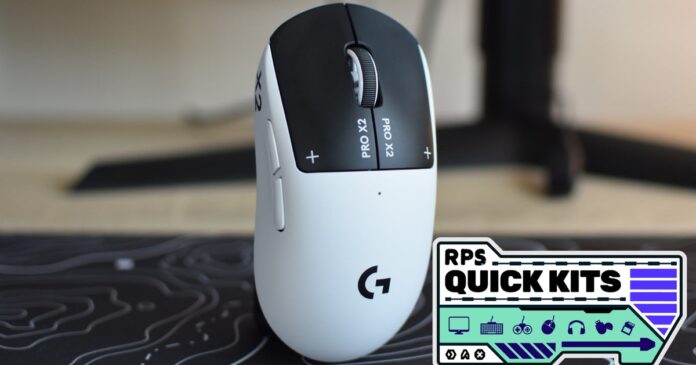
I don’t want to alarm anyone, but a gaming mouse has just tried something new. New and, it turns out, brilliant.
The Logitech G Pro X2 Superstrike is based on the already-excellent G Pro X Superlight 2, with all the lightness, grip-agnostic comfort, and sturdy wireless connectivity that entails. But this is much more radical than any direct upgrade, as the Superstrike lacks any conventionally clicky, contact-making switches in the main left and right buttons. Instead, it uses electromagnetic coils to register clicks, along with vibrating haptic motors to provide on-finger feedback.
Not unlike similarly magnet-minded Hall effect keyboards, Logitech say this allows for faster inputs and, thus, better responsiveness in games. Frankly, I couldn’t feel such a difference when shooting in Apex Legends or pushing my wizard dudes around in Dota 2. But then, speed isn’t really where the Superstrike’s appeal lies – it’s personalisation. Because the electromagnetic sensors let you manually adjust actuation distance (that’s how deep you need to press for a click to register), and the amount of haptic feedback is adjustable as well, this is a uniquely customisable mouse for getting the feel of clicks precisely how you’d like them. Real Goldilocks just-right shit. I, for one, went with a dual profile approach: fast, shallow actuation with a heavy, tactile haptic ‘click’ for games, while for desktop cursoring, I could swap to a deeper, less accident-prone pressing action with a lighter and quieter feedback setting.
This is a bigger step forward for gaming mice than it might sound. Unless you could try it beforehand, buying a new one has always carried the risk of getting stuck with something where the clicks are too loud or the buttons feel too light or the travel depth seems wrong. The Superstrike lets you tailor all of that to your exact tastes, while tweaking multiple profiles for different games or use cases. And the best part is that physically, there’s no real trade-off. Nothing about this mouse seems compromised to me, despite its flexibility, with the haptics being particularly impressive in their role as clickfeel replicators. On a high setting, their feedback is chunky, satisfying, and mechanical-like; on low, it’s pleasantly crisp, sharp, and light.
Again, it also shares successes with the Superlight 2: high build quality, low weight, a great sensor, a solid scroll wheel, and very agreeable battery life (I’ve used about 14% charge in four days of heavy use). The only problem is the high price, but then for such a well-made, high-performing, and exceptionally forward-thinking mouse, I don’t think even that can be held against it much. At worst, we should be crossing fingers, toes, and eyelashes that this clicking tech makes its way to more affordable rats in the future.
Quick Kits is a hardware review series about pouring as much fully-tested PC gear knowledge down your eyes as we can – within two or three paragraphs.